
Photo to 3D: How AI is Changing Asset Creation Forever
The era of manual mesh modeling is ending. Discover how raw photos are becoming the new source code for 3D worlds.
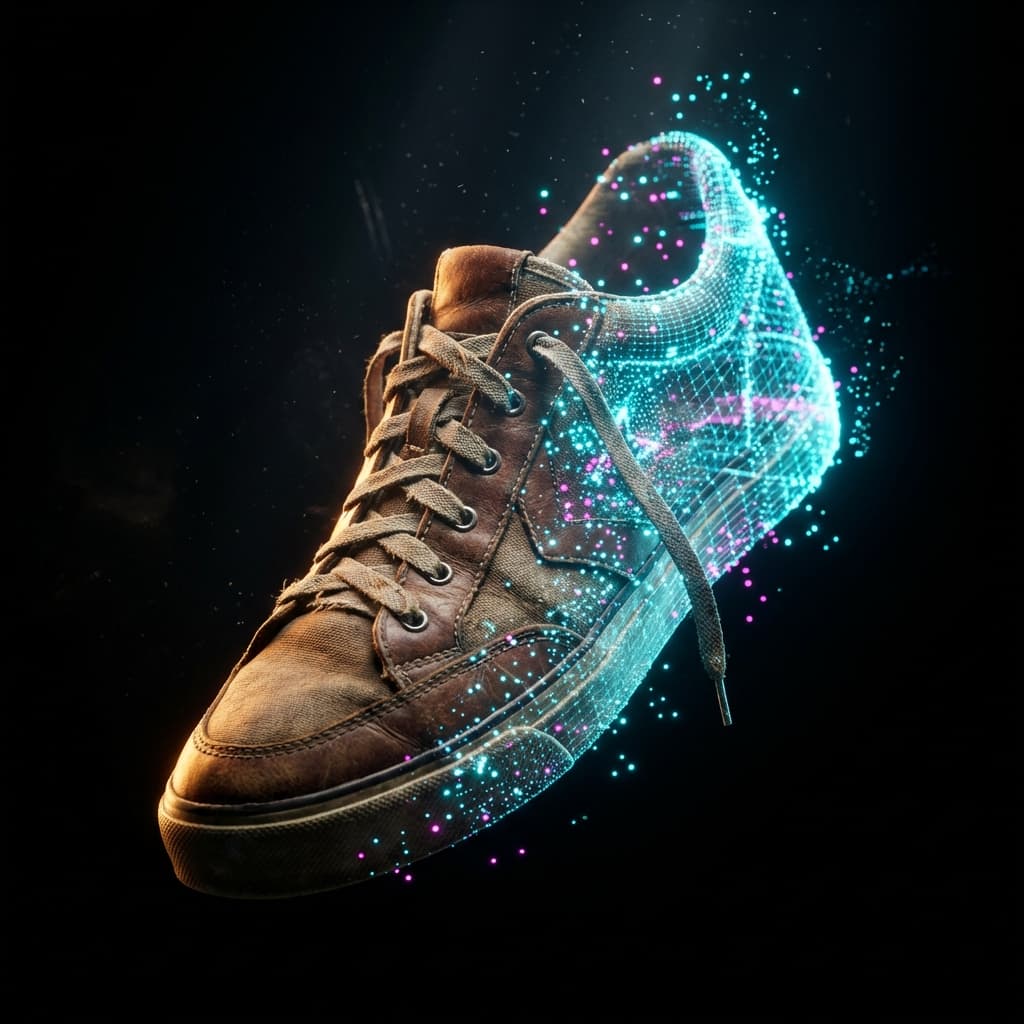

Key Takeaways
- AI is shifting 3D creation from "manual sculpting" to "computational synthesis."
- Production costs are dropping by up to 99%, making 3D viable for every product.
- New techniques like Gaussian Splatting offer photorealistic results in seconds.
- The future role of 3D artists is evolving into "3D Directors."
The Paradigm Shift: From Capture to Synthesis
For decades, creating a high-quality 3D asset meant one of two things: painstakingly modeling it vertex by vertex in software like Blender or Maya, or using expensive photogrammetry rigs with dozens of cameras. Both methods were slow, expensive, and reserved for big-budget productions.
We are now witnessing a fundamental shift. Generative AI and neural rendering technologies have turned 3D creation into a synthesis problem. Instead of "capturing" geometry, AI infers it. By analyzing millions of images, models can now predict how an object looks from every angle based on just a few photos - or even a single one.
The market reflects this explosion. The global market for AI image-to-3D generators is projected to grow at a staggering CAGR of over 23% through 2035. This isn't just a trend; it's an industrial revolution for digital content.
The New Workflow: Speed is the New Currency
Traditional workflows often look like this:
- Gather reference images.
- Block out base forms (1-2 hours).
- Sculpt high-poly details (4-8 hours).
- Retopologize for game engines (3-5 hours).
- UV unwrap & Texture (3-5 hours).
With AI-driven "Photo-to-3D" tools, the workflow collapses:
- Upload 1-5 photos of the object.
- AI infers geometry and texture (2-5 minutes).
- Human artist refines and optimizes (15-30 minutes).
The difference is exponential. We are moving from days per asset to minutes per asset.
3D Asset Production ROI
Compare the cost and time efficiency of AI-powered generation vs. traditional manual modeling.
From small collections to massive catalogs.
Typical rates range from $50 for simple props to $1000+ for complex assets.
Includes modeling, UV mapping, and texturing.
Projected Monthly Savings
The Tech Stack: NeRFs and Gaussian Splats
Two key technologies are driving this change. First, Neural Radiance Fields (NeRFs) showed us that a neural network could learn to represent a scene as a continuous volumetric field. While revolutionary, NeRFs were initially slow to render.
Enter 3D Gaussian Splatting. This newer technique represents scenes as a cloud of 3D "splats" - ellipsoids that can be rasterized in real-time. It combines the photorealism of NeRFs with the speed of game engines. For e-commerce and product visualization (which we discuss in our lightbox vs 3D comparison), this means you can have a digital twin of a sneaker or a handbag that looks indistinguishable from a video but runs smoothly in a web browser.
Traditional Mesh
Defined by vertices, edges, and polygons. Great for physics and standard game engines, but hard to make photorealistic without heavy textures.
AI/Gaussian Splat
Defined by point clouds and neural features. Inherently photorealistic and handles complex materials (fur, glass) much better.
Democratization: The "No-Code" 3D Era
The most profound impact of this technology is accessibility. Just as Canva made graphic design accessible to non-designers, AI 3D tools like Rendery3D, Luma AI, and Polycam are lowering the barrier to entry for 3D creation. Small business owners, indie game developers, and hobbyists can now generate assets that would have previously required a hired professional.
This doesn't mean the death of the 3D artist. Instead, it elevates them.
The Hybrid Future: The Rise of the "3D Director"
Will AI replace 3D artists? No, but it will change their job description. The role is shifting from manual labor (moving vertices) to art direction (curating outputs).
The "Hybrid Workflow" is already becoming the standard in top studios:
- AI for the "Boring" Stuff: Generating generic props, background assets, and base textures.
- Humans for the "Hero" Stuff: Character acting, stylized art direction, complex rigging, and final polish.
- AI + Human Cycle: Artist sketches → AI generates model → Artist sculpts details → AI generates textures → Artist finalizes lighting.
The Quality Gap
While AI is fast, it isn't perfect. Topology can be messy, and AI struggles with very specific engineering constraints. For architectural precision or manufacturing-ready CAD files, traditional parametric modeling is still king.
Summary: Is AI 3D Right for You?
We are in the early adoption phase, but the trajectory is clear. If you need speed, scale, and photorealism for web or AR, AI photo-to-3D is a game-changer.
Start exploring this tech if:
- You manage a large catalog of e-commerce products.
- You need rapid prototypes for game development.
- You want to create immersive AR experiences without a massive budget.
For enterprise solutions or custom implementations, contact our success team.
Ready to Turn Your Photos into Assets?
Join thousands of creators using Rendery3D to transform simple images into professional-grade assets in minutes.
Start Creating for Free