
3D Product Visualization
The Death of the Lightbox: Why 3D Models Are Replacing Traditional Product Photography
The photography studio had a good run. But in 2026, the numbers don't lie: 3D product visualization is faster, cheaper, and converts better. Here's the complete breakdown.
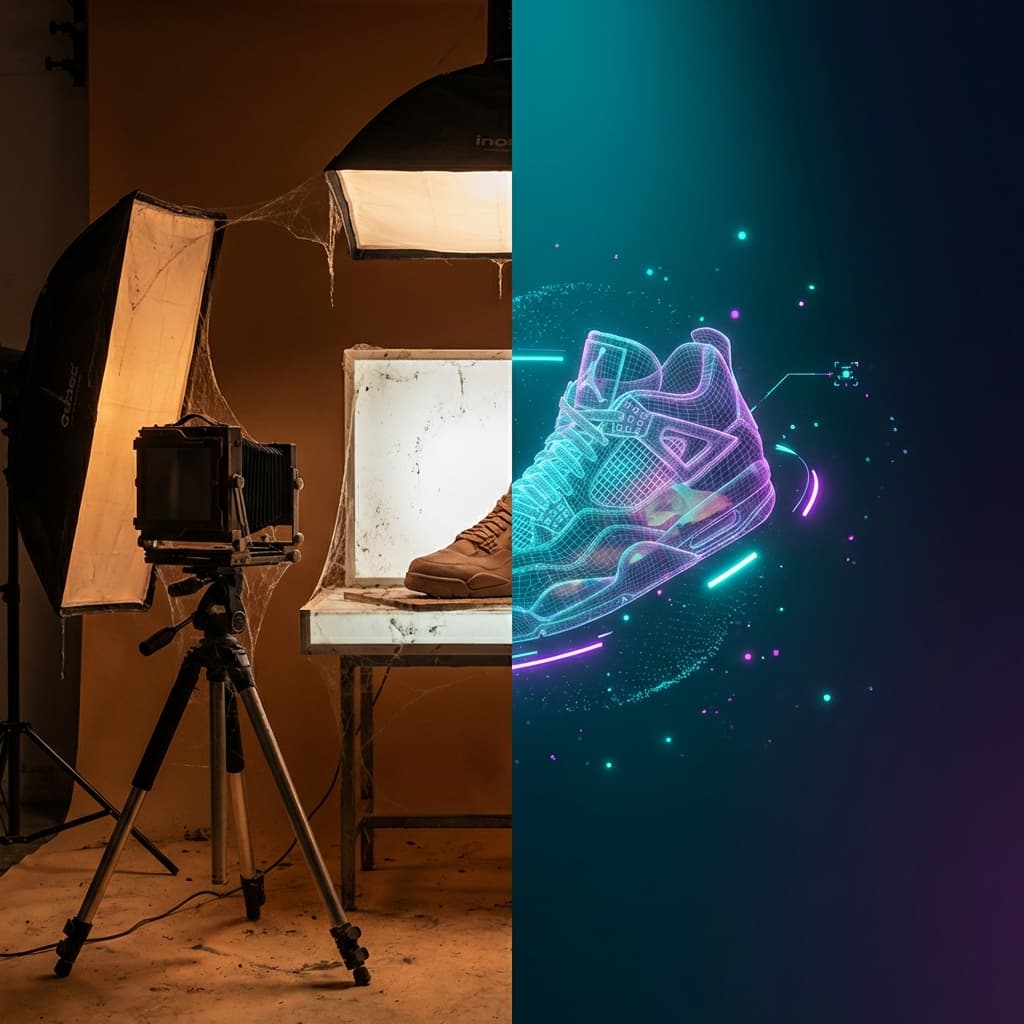

Picture this: a dusty photography studio, softboxes arranged perfectly, a product stylist adjusting the angle of a coffee mug for the 47th time. The photographer clicks. "One more." Click. "Just one more, the shadow isn't right." This scene - replayed millions of times across the e-commerce industry - is becoming a relic.
In 2026, 3D product visualization has grown into a multi-billion dollar market, expanding at 18% annually. Major retailers like IKEA, Wayfair, and Nike have have invested heavily in CGI for their product catalogs. The reason? A combination of economics, speed, and something traditional photography can never offer: infinite flexibility.
This isn't about technology for technology's sake. It's about cold, hard numbers: higher conversion rates (20-40% CVR lift, based on 3D visualization benchmarks), 35% fewer product returns, and 6x cost reduction compared to traditional studio photography. If you're selling on marketplaces like Amazon, understanding conversion rate optimization is crucial - and your imagery is a major lever.
1. The Rise of 3D Product Visualization
For a century, product photography followed the same formula: arrange the product, light it perfectly, capture it with a camera. But around 2020, something shifted. GPU rendering became fast enough, 3D modeling software became accessible, and AI-assisted workflows made photorealistic CGI achievable at scale.
What's Driving the Shift?
🚀 Technological Maturity
Real-time ray tracing, AI denoising, and procedural texturing now produce renders indistinguishable from photographs in a fraction of the time.
📈 E-commerce Explosion
Global e-commerce is a $6.3 trillion market. Brands need thousands of product images across multiple platforms - traditional photography simply can't scale.
🎯 Consumer Expectations
83% of consumers want to see products in 3D when shopping online. Interactive views, AR try-ons, and 360° spins are becoming baseline expectations.
⚡ Speed-to-Market Pressure
Fast-fashion and direct-to-consumer brands launch products weekly. waiting 3-5 weeks for physical photographyshoot is a competitive disadvantage.
The early adopters were furniture and home goods brands - IKEA famously revealed that 75% of their catalog images were CGI as far back as 2014. Today, the technology has matured to handle everything from fine jewelry with micro-reflections to fabric with thread-level detail.
2. Why 3D Beats Traditional Photography
Traditional photography has undeniable strengths - authenticity, tangible realism, the human touch. But for e-commerce product imagery, the advantages of 3D visualization are becoming impossible to ignore.
1Unlimited Variations, Zero Reshoots
Need your product in 12 colors? Traditional photography requires 12 separate shoots or labor-intensive color correction. With 3D, you change a material parameter and re-render in minutes. A single 3D model can generate hundreds of variations - different angles, colors, materials, and environments without touching a camera.
2Photograph the Impossible
Launching a product that doesn't exist yet? Need to show a car driving through a volcano? Want to display watch internals impossible to photograph? 3D has no physical constraints. Brands can create marketing assets and pre-sell products before manufacturing a single unit.
3Perfect Consistency at Scale
Every traditional photoshoot introduces variables: lighting fluctuations, camera positioning, color calibration. 3D renders are mathematically consistent. Light angle, shadow softness, and color values are identical across every image - critical for brand consistency across a 10,000-SKU catalog.
4Interactive Experiences
3D models can power experiences photography never could: 360° product spins, AR "try before you buy," virtual configurators. Shopify's research shows products with 3D/AR content see higher conversion rates (20-40% CVR lift, based on 3D visualization benchmarks). Photography captures a moment; 3D creates an experience.
💡The Hybrid Reality
This isn't an absolute replacement. Hero campaign shots for luxury brands, products requiring human models, and items where tactile authenticity is paramount still benefit from traditional photography. The smart play? Use photography for flagship content and AI-powered tools for everything else - lifestyle scene variations, catalog scaling, and rapid A/B testing.
3. The ROI Reality: Cost, Time, and Conversion
Let's talk numbers. The economics of 3D product visualization become more compelling the larger your catalog and the more frequently you need to update imagery.
| Metric | Traditional Studio | 3D/CGI Rendering |
|---|---|---|
| Per-image cost | $20 - $50 | $1 - $5 (after model created) |
| 3D model creation (one-time) | N/A | $50 - $300 per product |
| Studio rental | $500 - $800/day | $0 |
| Product shipping/logistics | $50 - $500 per shoot | $0 (CAD file upload) |
| Variation cost | Full reshoot | $0.50 - $2 per render |
| Turnaround time | 2-4 weeks | 24-72 hours |
| Long-term cost (large catalog) | 6x higher | Baseline |
The key insight: 3D has higher upfront costs (model creation) but dramatically lower marginal costs. Once a 3D model exists, generating new angles, colors, or scenes costs almost nothing. Traditional photography has no "asset" you can reuse - every update is a new expense.
📦Lightbox vs 3D: Cost Calculator
See why leading brands are ditching traditional photography for 3D product visualization
Traditional Lightbox
3D Product Visualization
3-Year Savings
$23,100
Cost Reduction
64%
Time Saved
18 weeks
Total Images
300
* Based on industry averages: $35/image traditional photography, $150 3D model creation, $2/render. Actual costs vary by provider and complexity.
Conversion Impact Data
+20-40%
Conversion rate increase with 3D/AR content
- Shopify Internal Data
-35%
Reduction in product returns
- Home Depot Case Study
+50%
More time spent on product pages
- Threekit Research
4. Types of 3D Product Imagery
3D visualization isn't monolithic. Different applications require different approaches - and choosing the right one impacts both cost and customer experience.
Static CGI Renders
The direct replacement for traditional photography. Photorealistic still images generated from 3D models. Indistinguishable from photos, infinitely configurable. Ideal for marketplace listings, catalogs, and advertising.
360° Interactive Spins
Let customers drag to rotate products. Typically 36-72 rendered frames stitched together. Studies show 360° views increase conversions by 47% and reduce returns by showing products from every angle before purchase.
AR/VR Experiences
Place products in customers' real-world spaces via smartphone AR. IKEA Place, Amazon's "View in Your Room," and Shopify AR all use 3D models. This requires optimized 3D assets but creates the most immersive product experiences possible.
Product Configurators
Real-time 3D renderers that let customers customize products: choose colors, materials, add engravings, swap components. Nike By You and Dell's laptop configurator are prime examples. Impossible with traditional photography.
CGI Animation & Video
Product reveal videos, exploded views showing internals, feature highlight animations. A single 3D model can generate unlimited video content - turntables, close-ups, assembly sequences without touching a camera.
The Asset Multiplier Effect
Here's what traditional photography misses: a single 3D product model can power all these applications simultaneously. One investment, infinite outputs. Your 3D model becomes a perpetual content engine - static images today, AR experiences tomorrow, video ads next week.
5. Making the Switch: A Practical Implementation Guide
Transitioning from traditional photography to 3D visualization doesn't happen overnight - and it shouldn't. Here's a pragmatic roadmap based on how successful brands have made the shift.
Phase 1: Pilot Program (Month 1-2)
Start with 5-10 products. Choose items that are:
- Available in multiple variants (colors, sizes) to test variation rendering
- Made of diverse materials (metal, fabric, plastic) to assess quality
- High-traffic products where you can measure conversion impact
Compare rendered images side-by-side with your existing photography. Run A/B tests to measure actual conversion differences.
Phase 2: Category Rollout (Month 3-6)
Expand to entire product categories. Prioritize:
- High-variant categories: Products with many color/material options benefit most from 3D's variation economics
- Frequently updated products: Seasonal items, fashion collections, limited editions
- New launches: Start building 3D assets for new products from day one
Phase 3: Enterprise Integration (Month 6+)
- Integrate 3D workflows with your PIM (Product Information Management) system
- Establish CAD-to-render pipelines with your product design team
- Deploy interactive 3D viewers and AR experiences on product pages
- Create automated rendering pipelines for catalog updates
⚠️Common Pitfalls to Avoid
- Skimping on 3D model quality: Low-poly or poorly textured models undermine the entire value proposition
- Ignoring material accuracy: Fabric should look like fabric, chrome like chrome. Inaccurate materials destroy trust.
- Inconsistent lighting: Match your brand's established visual style; don't let 3D feel "different"
- Forgetting mobile optimization: 3D viewers and AR must perform on lower-end devices
6. The Future is Dimensional: What's Next
We're still in the early innings of the 3D product visualization revolution. Here's what's emerging on the horizon:
🤖 AI-Generated 3D Models
The current bottleneck is 3D model creation - skilled artists, hours of work. But AI is rapidly automating this. Image-to-3D and text-to-3D models are improving monthly. By 2027, expect near-instant 3D model generation from photos, collapsing the cost barrier entirely.
🛒 Spatial Commerce
Apple Vision Pro, Meta Quest, and next-gen AR glasses are creating demand for 3D-native shopping experiences. Brands building 3D asset libraries today will be ready for immersive commerce platforms tomorrow. Those relying solely on 2D photography will scramble to convert.
🎯 Personalized Product Imagery
Imagine product images that adapt to each viewer: minimalist backgrounds for some, cozy home scenes for others, environments matching the customer's location or preferences - generated on-the-fly from 3D models. This is coming faster than most realize.
🎥 AI Video from 3D
Short-form video dominates social commerce. 3D models can already generate product turntables and feature highlight videos automatically. Next: AI creating narrative product videos - unboxings, tutorials, lifestyle clips - entirely from 3D assets.
The trajectory is clear: 3D product models are becoming the source of truth, from which all visual assets - images, videos, AR experiences, configurators - are derived. Traditional photography produces a single artifact. 3D produces an endlessly reusable digital twin.
7. When Traditional Photography Still Wins
Despite the overwhelming economics of 3D, traditional photography isn't dying everywhere. Be honest about where it still makes sense:
👕 Human Models
While AI-generated human models are improving, authentic photography of real people wearing or using products still converts better for fashion, beauty, and lifestyle brands. The "uncanny valley" hasn't been fully crossed.
🍎 Food & Organic Products
The imperfection of real tomatoes, the steam rising from hot food, the wet glisten on fresh produce - these nuances are extraordinarily difficult to render convincingly. Photography excels here.
💎 Ultra-Luxury Hero Shots
For flagship campaigns where tactile authenticity is paramount - fine jewelry, haute couture, artisanal goods - the subtle imperfections and "realness" of photography can convey quality CGI struggles to match.
📰 User-Generated Content
Authenticity-driven marketing - real customers using real products in real environments - can't be replicated with CGI. For social proof and community content, photography or video remains essential.
💡The Strategic Hybrid
The smartest brands aren't choosing sides - they're building hybrid workflows. Use traditional photography for hero campaign imagery and human-centric content. Use AI-powered visualization for everything else: catalog scaling, lifestyle scene variations, seasonal updates, and rapid A/B testing. The result? Premium brand perception with enterprise-scale efficiency.
Takeaways: The Lightbox Legacy
The economics are decided: 3D visualization is 6x cheaper at scale and infinitely more flexible. The question isn't if, but when to adopt.
Conversion data is clear: Interactive 3D and AR experiences drive higher conversions and 35% fewer returns. Static images can't compete.
Start building 3D assets now: Every 3D model is a perpetual content engine - images, videos, AR, configurators. Traditional photos are single-use.
Embrace hybrid workflows: Photography for authenticity and human elements; 3D for scale, variation, and interactivity. It's not either/or.
The future is spatial: AR, VR, and AI-generated content all require 3D assets. Brands building these libraries today will dominate tomorrow.
The lightbox had a remarkable century. It gave us catalogs, advertisements, and the visual language of commerce. But its reign is ending - not with a sudden collapse, but with a steady migration toward something more flexible, more efficient, and more experiential.
The products themselves haven't changed. But how we visualize them for customers has transformed forever. For a deeper dive into the AI side of this revolution, explore our guide to AI product photography.
Ready to Replace Your Lightbox?
Join thousands of creators using Rendery3D to transform simple images into professional-grade assets in minutes.
Start Creating for Free