
Creative Strategy
The "Us vs. Them" Comparison Ad
How to visualize product superiority in a way that drives clicks, survives ad review, and does not create legal exposure.
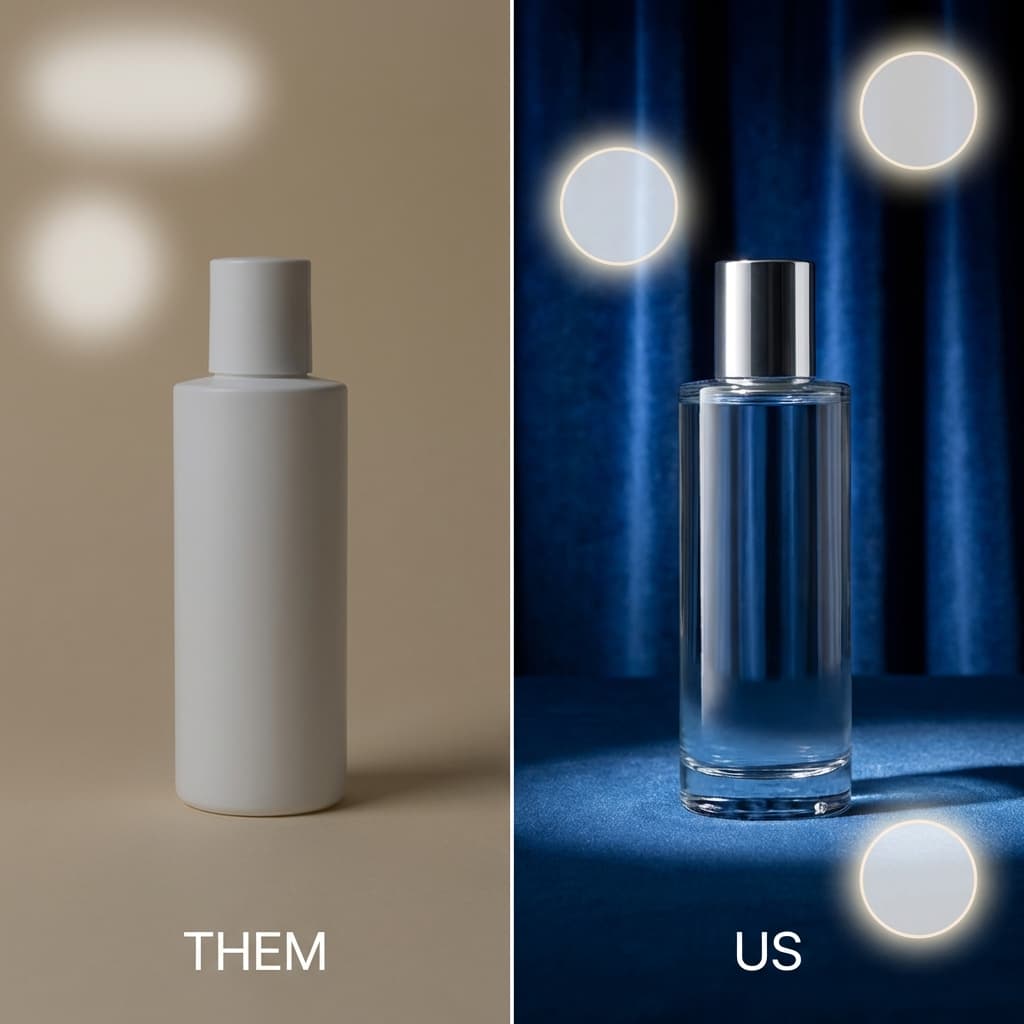

The "Us vs. Them" format is one of the fastest ways to communicate value. It reduces buyer effort because people do not need to imagine the difference, they can see it. But this format also creates the biggest compliance risk in most performance teams. One unclear claim, one outdated benchmark, or one misleading visual can get ads rejected or trigger legal disputes.
In this guide, you will get a practical workflow that starts with substantiation and then moves to creative. If you are currently fixing low quality product ads first, pair this with this DPA cleanup playbook so your comparison creatives inherit a stronger visual baseline.
Why "Us vs. Them" Works So Well
Comparison creative converts because it makes tradeoffs explicit. You are not asking a buyer to trust an abstract promise like "best quality." You are showing a direct difference in durability, speed, finish quality, fit, or total cost. When done correctly, this reduces ambiguity and increases confidence.
The FTC has long stated that comparative advertising can benefit consumers when claims are truthful and not deceptive. FTC comparative advertising policy. The key phrase is truthful and non-deceptive. This is the dividing line between a persuasive comparison and a liability magnet.
For channel context, Meta runs ad review against its advertising standards and automated plus manual checks. If a claim looks misleading, unclear, or unsupported, review friction rises. Meta ad review overview. For policy baselines on acceptable and prohibited advertising content, use: Meta Advertising Standards.
Legal and Policy Ground Rules
Claim Integrity
- Define what is being compared, and under what conditions.
- Use current data, especially for price comparisons.
- Document evidence before launch, not after rejection.
Creative Honesty
- Avoid manipulated before and after scenarios that imply impossible outcomes.
- Disclose test context when results depend on specific setups.
- Keep visual framing proportional to the actual difference.
The FTC truth-in-advertising standard is simple but strict: claims must be truthful, non-deceptive, and backed by evidence. FTC advertising FAQ. In practice, comparison ad disputes usually come from three errors:
- Stale benchmarks. If your price claim is weeks old, you can become misleading without changing one pixel. Recent NAD decisions on grocery price comparisons highlight this risk. NAD Lidl case.
- Overstated safety or superiority claims. Comparative claims that imply a competitor is unsafe need strong substantiation. NAD Beyond Air case.
- Creative exaggeration that changes implied meaning. Editing, color grading, or dramatic zoom can imply a larger performance gap than the data supports.
Build a Claim-Proof Matrix Before Design
Most teams do this backwards. They mock up a dramatic side-by-side, then scramble for proof. Instead, build a matrix first. One row per claim. One source of truth per row.
Claim-Proof Matrix fields
- Claim text: exact line that appears in ad copy.
- Comparison target: named competitor, market average, or prior model.
- Evidence source: lab test, internal QA protocol, third-party benchmark.
- Evidence date: last validated timestamp and owner.
- Disclosure needed: assumptions, limits, test conditions.
- Creative implication check: does the visual overstate the claim.
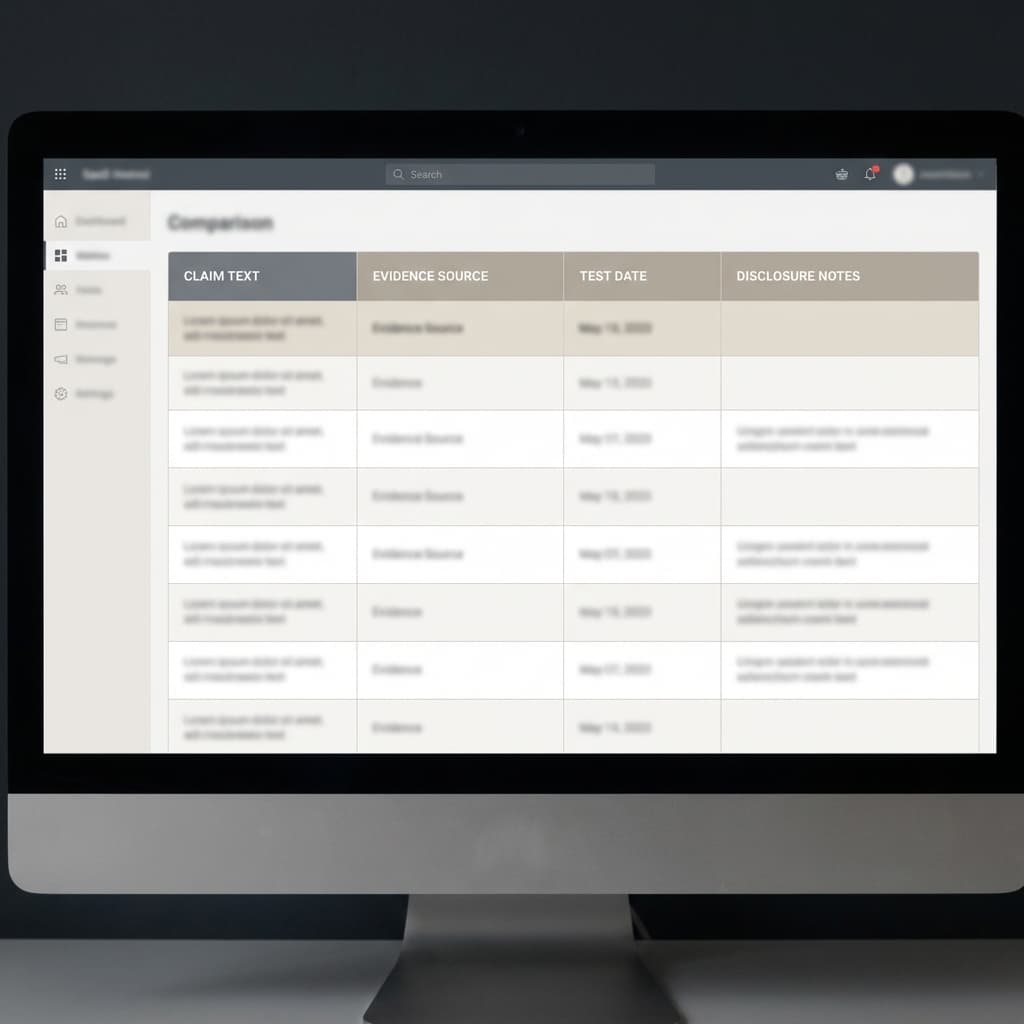
Once your matrix is approved, turn it into ad production constraints. This is where teams using a structured testing framework move faster, because legal review happens in the template stage instead of every single variant.
Claim Language and Disclosure Patterns
Creative teams often lose review because the claim text is too broad, not because the product lacks an advantage. Tight language is the safest path to scale.
High-Risk Phrasing
- "Best product in the market."
- "Works for everyone."
- "Guaranteed better than all competitors."
- "Clinically superior." without study details.
Safer Phrasing
- "Outperformed leading alternatives in internal durability test, January 2026."
- "Reduced setup time versus prior model under standard demo setup."
- "Lower 12-month refill cost versus selected alternatives."
- "Performance claim based on documented test protocol and conditions."
Use disclosures as context, not as camouflage. If a disclosure materially changes interpretation, it should sit close to the claim in readable size. FTC guidance on digital disclosures is still a useful operational reference for placement and clarity: FTC Dot Com Disclosures.
Risk Tiers and Signoff Model
Not all comparison claims need the same review depth. A tiered signoff model prevents over-review on low-risk creative and under-review on high-risk claims.
This governance model also helps during incidents. When a challenge arrives, you can identify who approved what, with which evidence package, and on which date.
Visual Frameworks That Stay Safe
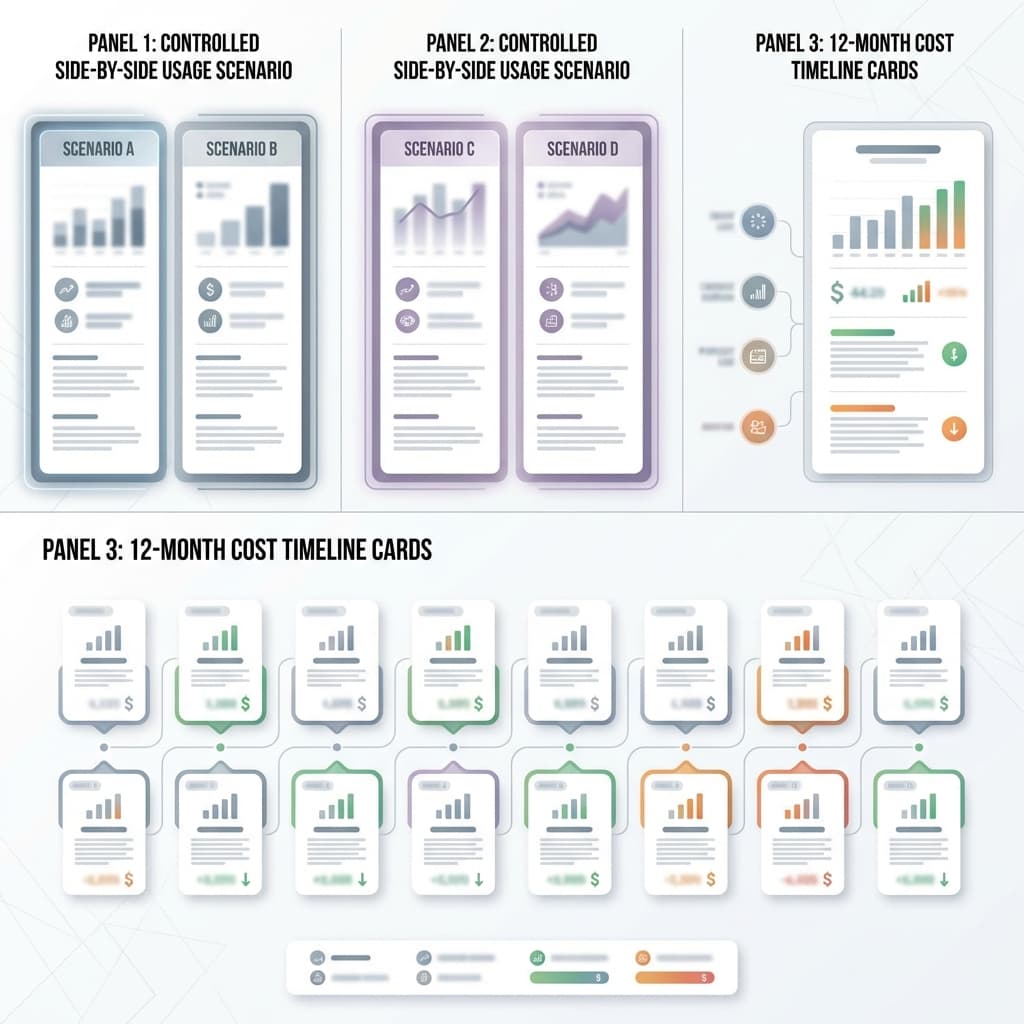
You do not need aggressive attacks to win the format. You need clear framing and consistent proof. Use one of these three structures:
- Attribute ladder: Compare 3 to 5 measurable attributes in the same order each time, such as durability, setup time, warranty, and refill cost.
- Scenario proof: Show the same use case for both products, with controlled lighting, same angle, and same duration.
- Cost timeline: Compare total cost over 3, 6, and 12 months instead of only first purchase price.
Common legal trigger to avoid
Avoid statements that imply universal superiority unless you can substantiate them broadly. "Outperforms leading alternatives under tested conditions" is usually safer than "best on the market."
Pre-Launch QA Sprint
Teams that launch comparison ads cleanly use a short but strict QA sprint. A practical baseline is a 72-hour cycle before spend goes live:
- Hour 0 to 24, evidence freeze: lock all claim sources, test dates, and disclosure text. No open placeholders.
- Hour 24 to 48, creative audit: verify visuals match the documented claim scope and do not imply unsupported outcomes.
- Hour 48 to 72, channel preflight: preview placements, check readability, and confirm final copy variants in ad manager.
Preflight checks that catch most failures
- All claims are traceable to one evidence record ID.
- Each variant includes the correct disclosure block.
- The competitor label is precise and consistent across headline, body, and visual.
- Landing page copy matches ad claim language exactly.
- Localized variants maintain disclosure intent after translation.
Video Walkthrough
Use this tutorial slot for your media team when building and reviewing comparison ad variants:
How to Measure Without Fooling Yourself
Comparison ads can spike CTR while hurting downstream quality if the promise is too aggressive. Track creative performance in layers:
Four-level measurement model
- Level 1: Thumb-stop metrics, CTR, hold rate, video completion.
- Level 2: Landing quality, bounce rate, session depth, add-to-cart.
- Level 3: Commercial outcomes, CPA, ROAS, payback period.
- Level 4: Risk outcomes, rejection rate, complaint rate, legal escalations.
Keep your holdout design clean. Compare against your own prior control creative, not against random seasonal periods. If you need a broader creative system, blend this method with your UGC versus polished split strategy so you can route comparison formats to the right campaign stage.
Challenge Response Playbook
Even strong campaigns can be challenged by platforms, competitors, or consumers. Fast response reduces downtime and protects budget efficiency.
- Pause only the challenged variant, keep unaffected ad sets active.
- Pull the original evidence package, including date-stamped test artifacts.
- Check whether the issue is claim text, visual implication, or missing disclosure.
- Issue a corrected variant with narrower language where needed.
- Log root cause and add one new preventive check to the QA sprint.
Build this as a standard operating procedure, not a one-off fix. The goal is repeatable recovery, not panic-based edits.
How Rendery3D Speeds Up Comparison Creative
Manual comparison production is usually slow and inconsistent. One version uses a warm background, the next version uses cool lighting, and suddenly the "result" looks different for reasons unrelated to product quality.
Rendery3D solves that by making your comparison variables explicit. Generate consistent product captures through AI product photography, then keep controlled environments with the AI background generator. Your team can test claim framing without contaminating the test with random lighting or angle changes.
Operational target
- Build one approved claim framework and produce 20 to 40 variants per week.
- Lock camera angle and light direction across all variants.
- Run structured legal and policy QA before budget scale.
Launch Checklist
- Each comparison claim has evidence, owner, and last validation date.
- Visual framing does not exaggerate beyond substantiated differences.
- Policy links and internal QA notes are attached to campaign docs.
- Control and test groups are defined before launching spend.
If you want to ship your first compliant comparison batch this week, start in Rendery3D and run your top 10 SKUs through a proof-first template.