
Brand Strategy
About Us: Visualizing Brand Authenticity (2026 Guide)
Why your "About Us" page is likely killing trust - and how to fix it by replacing stock photos with your brand's true DNA.
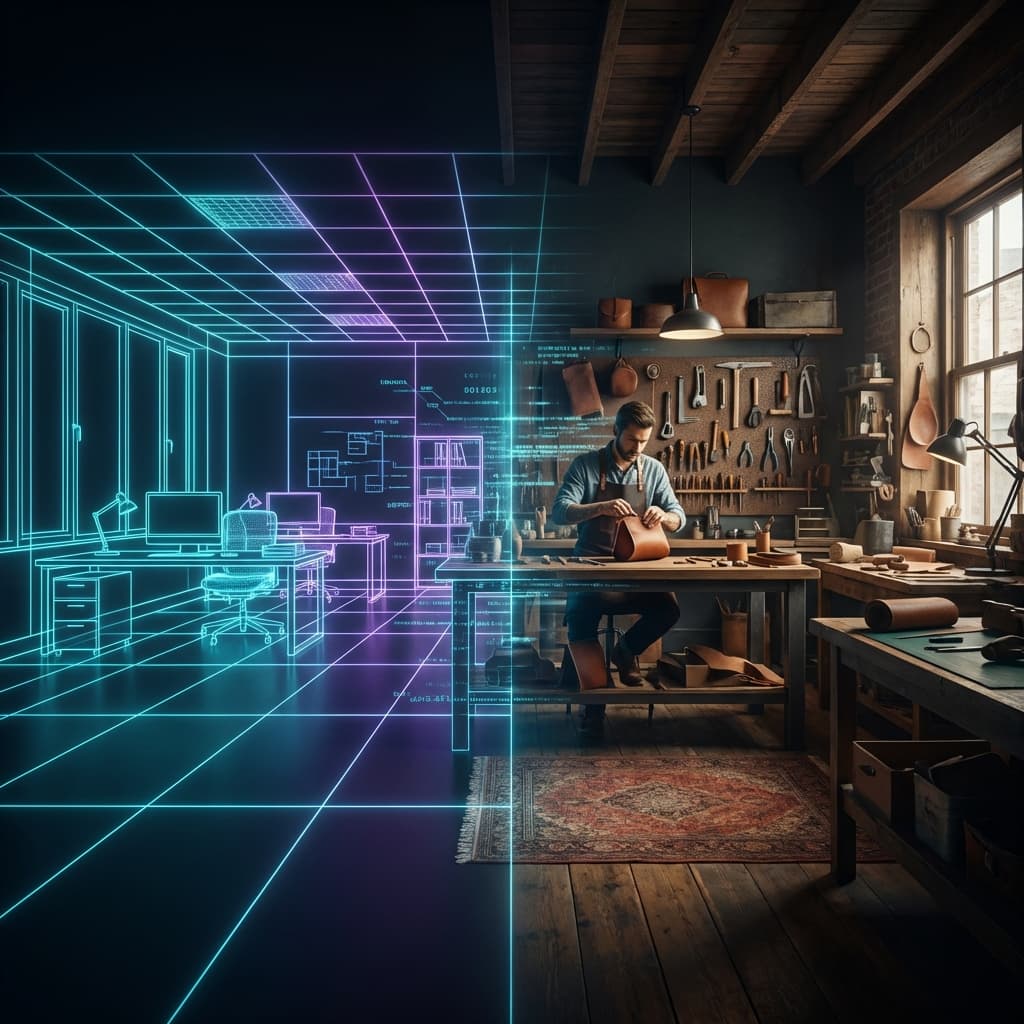

Your product photos look like everyone else's.
Authenticity is the currency of 2026. This guide explores the psychology of trust, why "perfect" photos hurt conversions, and how to use AI to generate imagery that feels deeply human and specific to your brand.
The 2026 Trust Crisis: Why "Perfect" is Dead
We need to talk about the "About Us" page.
For most e-commerce brands, this page is an afterthought. It's populated with a few paragraphs of generic text about "quality" and "innovation," and anchored by that image. You know the one. A diverse group of smiling professionals huddled around a laptop in a sun-drenched, open-plan office. They are pointing at something on the screen. They look ecstatically happy about a spreadsheet.
They also look completely fake.
In 2026, the consumer bullshit detector is more sensitive than ever. After a decade of deepfakes, drop-shipping scams, and AI sludge, "perfect" has become suspicious. If a photo looks too clean, too balanced, or too generic, the brain subconsciously flags it as a lie.
According to recent consumer trust studies by Nielsen Norman Group, users ignore stock photos completely. They treat them as "filler content" rather than information. More damningly, conversion studies show that replacing stock photos with real people can meaningfully increase conversion rates or more.
When a customer lands on your site, they are asking one subconscious question: "Is this a real company run by real humans, or is it a shell entity that will disappear after I enter my credit card?"
If you answer that question with a $15 image from Shutterstock, you have already lost.
The "Trust Gap" Statistic
Websites featuring authentic founder or team photos see a higher conversion rates than those relying on stock imagery. In high-ticket categories, this gap widens to nearly 50%. Your "safe" choice of a professional stock photo is actually a conversion killer.
Interactive: Check Your Authenticity Score
Before we dive into the solution, it's critical to audit your current standing. Be honest with these questions. Nobody can see your results but you.
Brand Authenticity Checker
Question 1 of 4Do you use generic stock photos (e.g., "team looking at laptop") on your About Us page?
The Psychology: Why We Crave the "Mess"
Why do authentic photos convert better? It comes down to a psychological concept called Signal Theory.
In biology, a "costly signal" is a trait that is hard to fake. A peacock's tail is a costly signal - it's heavy, makes the bird slow, and requires massive energy to grow. Therefore, a peahen knows a male with a big tail is truly healthy. He couldn't fake it.
In business, stock photos are a "cheap signal." Anyone with $20 can buy a photo of a high-end office. It proves nothing. It signals low effort and low resources.
An authentic photo - even a slightly messy one - is a "costly signal."
- Specificity signals reality. A photo of your specific cluttered workbench with leather scraps and a half-drunk coffee proves you actually make the bags. You can't download that from Getty Images.
- Imperfection signals honesty. A "perfect" white lab coat looks like a costume. A lab coat with a small coffee stain or a wrinkle looks like someone who works. We trust workers; we distrust models.
- Texture signals touch. Stock photos are often flat and over-lit. Real life has shadows, grain, and texture. When we see texture, our brain simulates "touching" the object, which creates a sense of ownership and reality.
When you show the "mess" - the raw materials, the hands at work, the imperfect sketch - you are proving your existence. You are offering a costly signal that says, "We do this for real."
Defining Your Brand DNA (Visual Framework)
So, how do you operationalize this? You need to define your Brand DNA. authentic imagery isn't just "not stock photos." It's imagery that visually encodes your company's values.
Think of Brand DNA as a set of visual sliders you need to obtain for every image you publish.
1. Assessment: The "Generic Trap"
- Generic "team meeting" stock photos
- "We provide quality solutions" text
- Everything is perfectly white/clean
- Models looking at camera and smiling
2. Goal: The Authentic Brand
- Process shots (hands, tools, screens)
- Specific stories ("How we fixed X")
- "Lived-in" environments (mess is okay)
- Candid focus (looking at work, not lens)
The 3 Pillars of Visual DNA
- Environment: Where does your brand "live"? Is it a sun-drenched California studio? A dark, neon-lit coding den? A dusty, wood-scented workshop? Define the walls, the floor, and the light.
- Tools of Trade: What specific objects prove your work? For a coffee roaster, it's not just beans; it's the scoop, the burlap texture, the steam. For a SaaS company, it's the specific IDE theme, the whiteboard scribbles, the stickers on the laptop.
- Light Signature: Generic photos have flat, bright light. Authentic photos have mood. Are you "Golden Hour" (warm, low sun) or "Clinical Clean" (cool, bright white)? Pick one and own it.
Example Archetypes: The Maker vs. The Innovator
To help you visualize this, here are two distinct "Brand DNA" profiles. Notice how differing details tell a completely different story about the company.
Archetype: "The Digital Artisan"
Leather goods, coffee, craft spirits.
- Lighting: Warm, side-lit (Chiaroscuro), creating deep shadows.
- Texture: Wood grain, burlap, brass, dust particles in air.
- Chaos Level: High. Tools scattered, scraps on floor.
- Key Props: Calipers, sketchbooks, old rulers, coffee mugs.
- Vibe: "We serve people who appreciate the slow method."
Archetype: "The Future Builder"
SaaS, med-tech, performance supplements.
- Lighting: Cool white, diffuse, neon accents (cyberpunk hints).
- Texture: Matte plastic, brushed aluminum, glass, code.
- Chaos Level: Low but specific. Whiteboards full of diagrams.
- Key Props: Mechanical keyboards, tablets, prototypes.
- Vibe: "We are building the tools of tomorrow."
If "The Future Builder" used the "Digital Artisan" lighting, they would look outdated. If "The Digital Artisan" used the "Future Builder" lighting, they would look clinically mass-produced. Alignment is key.
The Hard Way: Why Manual Photoshoots Fail
Most founders understand the need for authenticity. They want to do it right. So they decide to organize a brand photoshoot.
If you have never done this, here is the brutal reality of what a "simple" brand shoot entails to get high-end results:
- Cost: A reputable commercial photographer starts at $1,500/day. A great one is $5,000+. This doesn't include models ($500/day each), location rental ($1,000+), or props ($500+). You are looking at $3k–$8k minimum.
- Logistics: You need to scout usage rights for locations. You need to insure the gear. You need to coordinate schedules. If it rains on the one day you rented the "sun-drenched loft," you lose your deposit.
- The "Shot List" Trap: You will likely get 500 photos, but only 3 will be usable. Why? Because unless you are an experienced art director, you won't notice that the lighting was slightly off or the model's expression was weird until it's too late.
- Static Results: This is the killer. Once you have those photos, they are frozen in time. Launch a new product next month? You can't add it to the group shot. Pivot your brand color from blue to green? The photos are useless. You have to start over.
Video: The "Authenticity" Struggle
This friction is why brands default to stock photos. It's not because they prefer them; it's because the authentic path feels impossible to sustain.
The Easy Way: Visualizing Authenticity with AI
This is where generative AI changes the physics of brand building. Tools like Rendery3D's AI Photographer allow you to inject your product's "Brand DNA" into any environment instantly, creating images that look 100% authentic to your brand, without a camera.
Here is the workflow for creating "About Us" assets that convert, using AI:
Step 1: The "Messy" Audit
Take a photo of your actual workspace. Don't clean it up too much. Capture the tools, the lighting, and the vibe. This isn't for publication; it's for reference. Upload this to Rendery3D as a style reference.
Step 2: Define the Prompt with "Costly Signals"
Instead of prompting for "professional product photo," prompt for the imperfections.
"Running shoe on a table, professional lighting, 4k."
// Authentic Prompt:
"Running shoe resting on a worn asphalt track surface, early morning mist, golden hour rim lighting, shallow depth of field, sweat towel in background, highly detailed texture."
See the difference? The second prompt encodes time of day, specific location texture (worn asphalt), and context (sweat towel). It tells a story.
Step 3: Generate "Process" Imagery
Use Rendery3D to visualize your product in the making. Even if you don't have a factory, you can generate a shot of your product drawings on a desk, or your prototype on a cutting mat.
This is called "Virtual Behind-the-Scenes." It allows you to tell the story of your craftsmanship visually, even if you are currently working out of a garage that isn't photogenic. You project the truth of your process (care, detail, design) onto a canvas that matches your brand aspiration.
Step 4: Consistent Team Avatars
If your team is remote and you only have mismatched selfies, AI can unify them. Using custom preset, you can take a low-quality selfie and reimagine it with consistent lighting and background that matches your product shots. Now your team page looks like you all sat for the same portrait session.
Pro Tip: Mixing Medias
The highest trust often comes from a mix. Use widespread AI generated backgrounds for your products to set the high-end mood, but intersperse them with raw, unedited iPhone videos of you holding the product. The contrast between the "high polish" AI and the "raw" video confirms that both are real.
The 5-Shot Authenticity Shot List
If you are rewriting your "About" page today, these are the 5 essential images you need to generate to tell a complete story.
The "Origin" Shot (The Garage)
Show where it started. Even if you didn't actually start in a garage, visualize the concept of your humble beginnings. A messy desk, a late night, a prototype.
Prompt: "First prototype of a ergonomic mouse on a cluttered kitchen table at night, single lamp lighting, coffee stains, notebook with sketches."
The "Hands" Shot (Craftsmanship)
Close up on hands doing the work. Hands are the universal symbol of effort. Sewing, typing, soldering, pouring.
Prompt: "Close up macro shot of hands stitching leather, focus on the needle, motion blur, sawdust in air, warm artisan lighting."
The "Tools" Shot (Expertise)
Knolling shot (flat lay) of the specific tools you use. This proves you know your trade.
Prompt: "Knolling photography of coding equipment, mechanical keyboard, server rack key, ethernet cables, coffee, blueprint, matte black table."
The "Team Flow" Shot (Culture)
Not looking at the camera. A shot of the team looking at a whiteboard or a product. Intense focus, not fake smiles.
Prompt: "Three designers debating over a large architectural print, rolled sleeves, pointing at details, sun coming through warehouse windows, candid style."
The "Hero" Product in Context (The Result)
The final product, but used in the real world. Not a white background. It's dirty, used, and loved.
Prompt: "Muddy hiking boots resting on a rocky cliff edge, overlooking a misty valley, epic travel photography style."
3 Authenticity Traps to Avoid
Even when trying to be authentic, brands fall into "Uncanny Valley" traps.
1. The "Too Perfect" Mess
Don't art direct the clutter too much. If every pen is perfectly aligned at 90 degrees, it looks like a stock photo again. Allow for true randomness.
2. The "Fake Candid"
Avoid the "laughing at salad" syndrome. Real work isn't usually hilarious. It's focused. Use prompts like "intense focus," "serious," or "deep in thought."
3. Inconsistent Lighting
Don't mix a moody, dark workshop photo with a bright, high-key team photo. The clash kills the "world building" effect.
Implementation Checklist for Your Team
Don't let your brand story fade into the background. Here is your action plan for this week to fix your "About Us" page:
- Audit & Purge: Go to your About, Contact, and Home pages. Delete any image that isn't specific to your company. If it's a stock photo of a handshake, a laptop, or a headset, delete it immediately.
- Define Your Environment: Write down 3 adjectives that describe your workspace vibe (e.g., "Industrial," "Warm," "Clinique").
- Generate the "Hero" Shot: Use Rendery3D's tools to place your flagship product in that specific environment.
- Add "Process" Visuals: Create at least one image showing the "making of" or the "designing of" stage.
- Rewrite captions: Don't just label images. Tell the story. "Our design studio" is boring. "Where we spent 400 hours refining the handle ergonomics" is a hook.
For more on how to create consistent visuals, read our guide on The "Nike Aesthetic".
Summary: The ROI of Being Real
Authenticity is no longer a "nice to have." It is a survival mechanism in an age of infinite AI slop. Brands that embrace the "mess," the texture, and the specificity of their DNA will build trust. Brands that hide behind perfect, generic stock photos will fade into obscurity.
Stock photos are a lie of omission. They omit the hard work, the passion, and the reality of your business. Authentic photos - whether captured by a camera or visualized by AI - tell the truth. And in 2026, the truth sells.
Key Takeaways
- Stock photos actively lower consumer trust (65% negative perception).
- "Costly signals" like specific textures and imperfections drive conversion.
- Brand DNA is composed of Environment, Tools, and Light Signature.
- AI allows you to bypass the $5k photoshoot while scaling authenticity infinitely.