
Creative Strategy
Stop the Scroll: Simple Product Motion
Using 3D turntable GIFs to triple CTR on TikTok. Why static images are invisible to the modern consumer and how to automate premium motion assets in minutes.

We live in the age of the Scroll Tax. Every millisecond your ad spends on screen without engaging the user is money burned. It is a merciless economy where "good enough" is synonymous with "invisible."
If you are still running static images on TikTok, Reels, or Shorts, you aren't just inefficient - you are fighting biology. The modern brain, over-stimulated and dopamine-dependent, filters out static content as "background noise" in a feed designed for motion.
The brands winning the attention war aren't shouting louder. They are moving smarter. They use Simple Product Motion - turntables, controlled hovers, 3D rotations - to subconsciously signal: "This is premium. Look at me."
The 8-Second Attention War
Banner blindness is real, and it has migrated to video.
According to TikTok Business: Creative Center, 90% of ad recall impact happens in the first 6 seconds. If those seconds are still, you have already lost. The platform itself penalizes low dwell time by restricting reach.
The Neuroscience: Why Motion Wins
It's not just about "looking cool." It's about how the human brain processes visual information. We can break this down into three biological triggers that advertisers can exploit.
1. The "Orienting Reflex" (Rod Cells)
Your eyes have two types of sensors: Cones (color/detail) and Rods (motion/light). Rod cells are concentrated in your peripheral vision and act as your survival radar. Any movement in your periphery triggers an involuntary "Orienting Reflex" - you must look at it to ensure it's not a threat. Motion hijacks this reflex.
2. The "Zeigarnik Loop" (Dopamine)
The brain seeks closure. Infinite loops - like a seamless 360-degree turntable - provide a rhythmic, satisfying stimulus without a clear "end." This creates a mild hypnotic state (a dopamine loop) where the viewer watches the same rotation 3-4 times without realizing it. This spikes your "Average Watch Time" metric significantly.
3. Reduced Cognitive Load
The brain processes visual information 60,000x faster than text. But a static 2D image still requires "mental work" to imagine the 3D form. Motion does this work for the viewer. By showing the back and sides of a product instantly, you reduce cognitive friction and build trust faster.
Case studies have consistently shown that interactive 360-degree views increased Click-Through Rate (CTR) by 2.5x and conversion rates by 55% (Source: Nfinite).
Interactive: Calculate Your Lost Revenue
Think staying static is "safer"? Use this calculator to see how much revenue you are leaving on the table right now by settling for average click-through rates.
Motion ROI Calculator
See how much revenue you're leaving on the table with static ads.
Average static image CTR is usually 0.9% - 1.5%
*Projections based on conservative 2.2x CTR lift from motion assets verified by industry benchmarks.
The 4 Types of "Simple" Motion
When we say "Simple Product Motion," we don't mean complex Pixar-level animation. We mean focused, looped movements that highlight the product itself. Here are the four most effective types you should be testing:
1. The Classic Turntable
What: A smooth 360-degree spin on a clean axis.
Why: Builds complete trust by showing "nothing to hide." Perfect for shoes, electronics, and intricate packaging.
2. The "Levitation" Hover
What: The product floats gently up and down, slightly rotating.
Why: Implies lightness and premium quality. The "magical" anti-gravity effect is a strong thumb-stopper.
3. The Dolly Zoom
What: The camera pushes in quickly while the background shifts.
Why: Creates an aggressive "in your face" effect. Use this for high-energy products like supplements or sports gear.
4. The "Pop-Out"
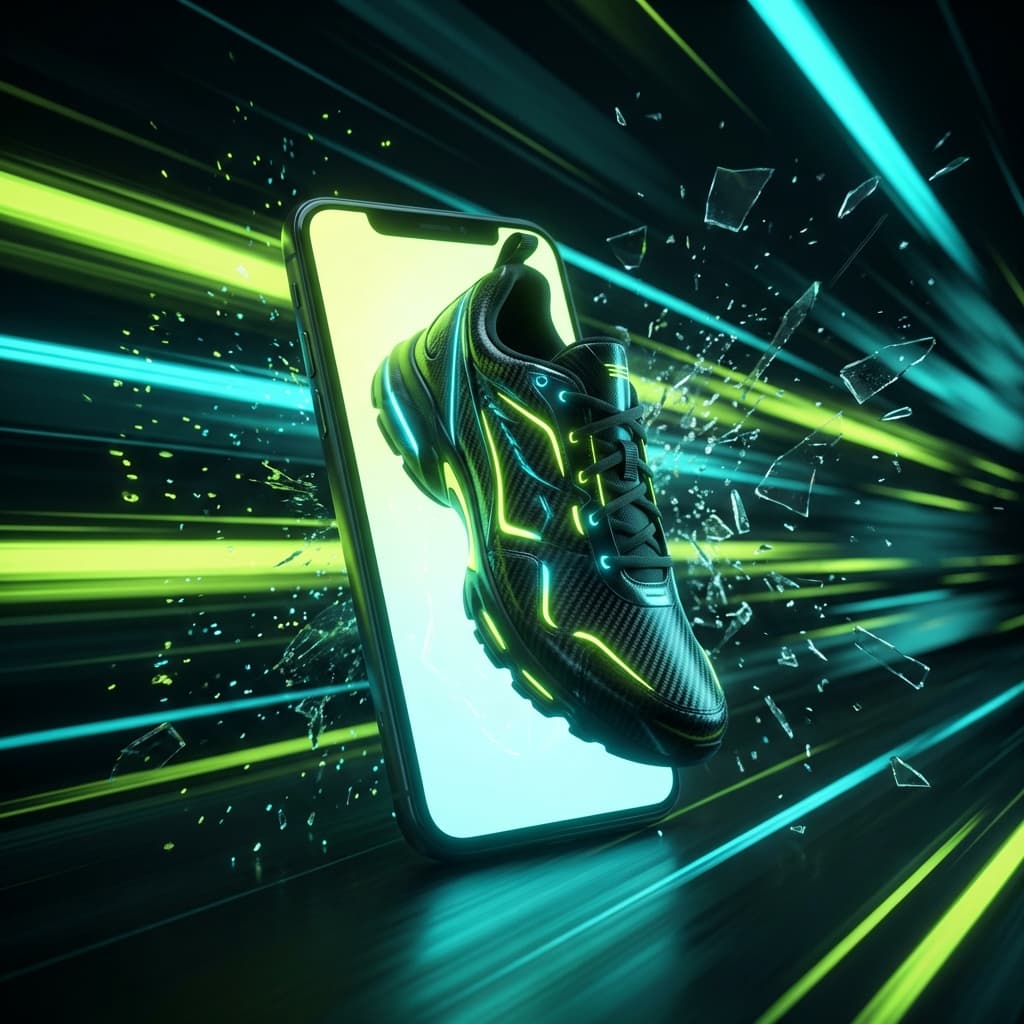
What: The product rotates past the frame boundaries, appearing to break the phone screen.
Why: Exploits the 3D depth perception to startle the user (in a good way). Highest CTR potential.
The Hard Way: Studio Turntables
So, if motion is so powerful, why doesn't everyone do it?
Because traditionally, creating a high-quality product turntable is a logistical nightmare. It is the bottleneck that kills creative testing velocity.
The "Manual" Workflow of Doom:
- Hire a Specialist Studio: Find a photographer with a motorized turntable rig. ($$$)
- Ship Product: Wait 3-5 days for shipping. Pay for return shipping.
- 36-Frame Photography: They must take 36 perfect photos at precise 10-degree angles. Any lighting flicker ruins the loop.
- Post-Processing Hell: Every single one of those 36 photos needs background removal, color correction, and perfect alignment.
- Stitching: You need specialized software to stitch them into a smooth GIF or MP4.
For a creative testing framework that requires 3-5 new angles a week, this is impossible. You cannot wait 2 weeks to test a single creative hypothesis.
Expert Strategy: Native Ads
Before we solve the production bottleneck, let's look at how to use these assets.
This breakdown by Ecom Mastery explains perfectly why "Native" feel is crucial. Your 3D motion shouldn't look like a TV commercial. It should look like a cool product showcase you'd see on your For You Page.
Key Takeaway: The Algorithm Test
TikTok tests your ad with a small audience first (approx. 300-500 impressions). If they don't engage (stop scrolling), the ad dies. 3D motion is the "cheat code" to pass this initial test and unlock broad reach.
The Solution: AI-Generated Motion
This is where the game changes. You no longer need a studio, a turntable, or 2 weeks.
With Rendery3D's AI Generator, you can turn a single static photo into a fully rotating 3D video. We utilize advanced Gaussian Splatting Technology to infer depth, geometry, and texture from a flat image.
Take a photo of your product on your desk. No fancy lighting needed. Our AI separates the object from the background and builds a localized 3D mesh.
Choose your animation style. Simple spin, hover, or "pop-out" 3D effect. You can also adjust the speed and loop duration.
Download a ready-to-use asset optimized for TikTok (.mp4) or Email Marketing (.gif). Total time: ~3 minutes.
This creates Creative Velocity. You can test 10 different motion hooks in the time it takes a competitor to pack a box for shipping.
Common Mistakes to Avoid
Motion is powerful, but "bad" motion can be nauseating. Avoid these traps:
- The "Drill" Effect: Spinning too fast. This makes the product look cheap and can actually cause motion sickness. Aim for a slow, premium 4-6 second loop.
- The "Glitchy" Loop: If the first and last frames don't match perfectly, the brain notices the "cut," breaking the hypnotic effect. Rendery3D ensures mathematically perfect loops.
- Ignoring Audio: On TikTok, 88% of users view with sound on. Don't rely only on the visual loop. Pair your premium motion with widespread trending audio for maximum effect.
Your 30-Day Action Plan
First 48 Hours
- Audit: Identify your bottom 3 performing static ads.
- Create: Use Rendery3D to generate 3 variations of motion (Turntable, Hover, Pop-Out) for these products.
Day 3-7 (The Test)
- Launch: Run a split test (A/B) on TikTok. Keep audience/copy identical. Only change the creative.
- Measure: Look specifically at "3-Second Video Views" and "CTR". Ignore ROAS for the first 48h.
Day 30 (Scale)
- Iterate: Take the winning motion style and apply it to your best-sellers.
Don't let your best products be ignored. Make them move.
Create Your First 3D Motion Asset